Geography is the study of the Earth's landscapes, features, inhabitants, and natural phenomena. It aims to understand the locations of various elements, the reasons for their presence, and how they evolve and transform over time.
-
Question 1791: Flax, cotton, olive and groundnuts are all important sources of?
Options:
A) synthethic fibres
B) animal feeds
C) artificial silk
D) vegetable oil
Show Answer
The correct answer is A .
-
Question 1792: Desert plants are usually called
Options:
A) hydrophytes
B) mesophytes
C) xerophytes
D) sporophytes
Show Answer
The correct answer is C .
-
Question 1793: One serious environmental hazard which may result from the destruction of the zone layer is?
Options:
A) flooding due to melting of snow
B) pollution of rain water
C) increase in atmospheric temperature
D) decrease in the quantity of oxygen in the atmosphere
Show Answer
The correct answer is C .
-
Question 1794:
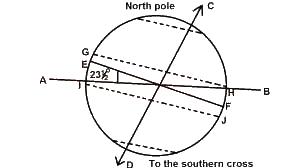
If the scale of a map is 2cm to 1km, what is the ground distance if the distance between two towns on the map is 20cm
Options:
A) 5km
B) 2.5km
C) 10km
D) 20km
Show Answer
The correct answer is C .
-
Question 1795: The processes by which materials are physically transferred from one soil layer to another is called
Options:
A) leaching
B) physical weathering
C) illuviation
D) eluviation
Show Answer
The correct answer is A .
-
Question 1796: Which of the following systems provides both irrigation water and hydro-electricity?
Options:
A) Gezira
B) Aswan
C) Shiroro
D) Volta
Show Answer
The correct answer is B .
-
Question 1797: The main use of Abney level in survey is to determine the
Options:
A) Angle of inclination
B) Relative location
C) Area coverage
D) Spot height
Show Answer
The correct answer is A .
-
Question 1798: If the standard time is of a country is GMT + 1hr, which longitude's local time is adopted by the country?
Options:
A) 60°W
B) 60°E
C) 16°W
D) 15°E
Show Answer
The correct answer is D .
-
Question 1799: Which of these sets of features enhance the nucleation of settlements?
Options:
A) Route intersections and wet points
B) Fertile broad plains and natural harbours
C) Narrow valleys and rugged highlands harbours
D) Dissected plains and route intersections
Show Answer
The correct answer is A .
-
Question 1800:
Study the table below, which shows the mean climatic conditions at station Y an d answer the question below
| J | F | M | J | J | J | A | S | S | O | N | D |
| *T (oC) | 22.1 | 24.1 | 27.5 | 30.9 | 31.5 | 30.0 | 27.3 | 25.8 | 26.7 | 27.7 | 25.2 | 22.7 |
| *R(mm) | 0 | 0 | 0.3 | 7.6 | 40.6 | 68.6 | 175.3 | 233.5 | 104.1 | 20.8 | 0 | 0 |
*T = Temperature*R = Rainfall
Station Y is located in the northern Hemisphere because the
Options:
A) The rainfall pattern is seasonal
B) temperature of the warmest month is 31.5oC
C) highest rainfall is in August
D) coolest period is from November to February
E) annual range of temperature is 9.4oC
Show Answer
The correct answer is E .