A) hydrogen and trioxocarbonate (IV) acid
B) hydrogen, oxygen and carbon (IV) oxide
C) hydrogen and carbon (ii) oxide
D) hydrogen and carbon (IV) oxide
Show Answer
The correct answer is C .
When dilute aqueous solutions of lead (II) nitrate and potassium bromide are mixed, a precipitate is observed.
The products of this reaction are?
Options:A) PbO(s) + Br- + KNO3
B) Br2 + NO2(g) + PbBr2(s)
C) PbO(s) + K+(aq) + Br(aq) + NO2(g)
D) PbBr2(s) + K(aq) + K+(aq) + NO3(aq)
Show Answer
The correct answer is D .
If acidified Potassium Dichromate(VI) (K
A) yellow to green
B) orange to green
C) yellow to red
D) orange to red
Show Answer
The correct answer is B .
A) 64.0g
B) 32.0g
C) 16.0g
D) 6.4 g
E) 3.2g
Show Answer
The correct answer is E .
A) NaHSO4
B) Na2SO3
C) NaHSO3
D) Na2SO4
Show Answer
The correct answer is B .
What is the PH of 0.00 1 moldm
A) 14
B) 13
C) 12
D) 11
Show Answer
The correct answer is D .
A) Ether
B) Methane
C) Butane
D) Ethene
E) Hydrogen
Show Answer
The correct answer is E .
Which of the following is a common laboratory indicator for bases?
Options:A) Methyl orange
B) Phenolphthalein
C) Bromothymol blue
D) Litmus
Show Answer
The correct answer is B .
A) nearly equal masses with a relaese of energy and radiaton
B) equal masses with a relaese of energy
C) equal masses with a release of energy and radiation
D) unequal masses without any relaese of energy
Show Answer
The correct answer is A .
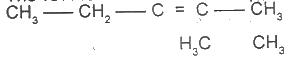
The IUPAC name for the compound is
Options:A) 2,3-dimethylpent-2,3-ene
B) 2, 3- dimethylpent-2-ene
C) 3, 4-dimethylpent-3-ene
D) 3,4-dimethylpentene
E) 3,4-dimethlhept-2-ene
Show Answer
The correct answer is B .