How many moles of limestone will be required to produce 5.6g of CaO?
[Ca = 40, C = 12, O= 16]
Options:A) 0.20 mol
B) 0.10 mol
C) 1.12 mol
D) 0.56 mol
Show Answer
The correct answer is B .
A) 0. 1, 0 . 1
B) 0. 1, 0. 2
C) 0. 1, 0. 05
D) 0.05, 0.1
Show Answer
The correct answer is C .

In the diagram above, curve X represents the energy profile for a homogeneous gaseous reaction. Which of the following conditions would produce curve Y for the same reaction?
Options:A) Increase in temperature
B) Increase in the concentration of a reactant
C) Addition of a catalyst
D) Increase in pressure
Show Answer
The correct answer is C .
A) neutral non-metal
B) metallic ion
C) non-metallic ion
D) neutral metal
Show Answer
The correct answer is B .
A) the zinc is in the powered form
B) a greater volume of the acid is used
C) a smaller volume of the acid is used
D) the reaction vessel is immersed in an ice-bath
E) the zinc is in the form of pellets
Show Answer
The correct answer is A .
A) boiling point
B) density
C) rate of diffusion
D) solubility
Show Answer
The correct answer is A .
A) Na2CO3
B) Mg(OH)CI
C) NaHCO3
D) KSO4.AI2(SO4)3,24H2O
Show Answer
The correct answer is B .
A) increase the amount of Z produced in a given time
B) increases the rate of change in concentrations of X, Y and Z
C) increases the rate of disapearance of X and Y
D) increases the rate of the forward reaction
E) decreases the amounts of X and Y left after the attainment of equilibrium
Show Answer
The correct answer is B .
A) barium
B) potassium
C) manganese
D) aluminium
Show Answer
The correct answer is B .
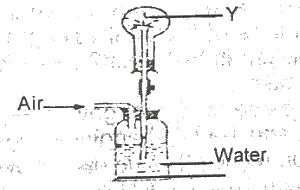
In the diagram above the gas Y could be
Options:A) hydrogen chloride
B) oxygen
C) carbon (IV) oxide
D) chlorine
Show Answer
The correct answer is A .