What is the concentration of a solution containing 2g of NaOH in 100cm3 of solution?
[Na = 23, O = 16, H = 1]
A) 0.40 mol dm-3
B) 0.50 mol dm-3
C) 0.05 mol dm-3
D) 0.30 mol dm-3
Show Answer
The correct answer is B .
A) automobile exhaust and biological decomposition
B) combustion of coal and automobile exhaust
C) biological decomposition only
D) combustion of coal, automobile exhaust and biological decomposition
E) combustion of coal and biological decomposition
Show Answer
The correct answer is B .
The percentage of water of crystallization in ZnSO4.7H2O is
[Zn = 65, S = 32, O = 1, H = 1]
Options:A) 33%
B) 44%
C) 55%
D) 87%
Show Answer
The correct answer is B .
A) -4
B) +4
C) -2
D) +2
Show Answer
The correct answer is C .
A) Carbon (II) oxide
B) Carbon (IV) oxide
C) Oxygen
D) Hydrogen
Show Answer
The correct answer is B .
A) CO2
B) SO3
C) CH4
D) H2
Show Answer
The correct answer is A .
From the graph above, it may be concluded that
Options:A) AgNO
B) NaCl is insoluble in water
C) Pb(NO
D) The solubility of KCIO
Show Answer
The correct answer is C .
A) High temperature
B) Any temperature
C) Low temperature
D) Minimum temperature
Show Answer
The correct answer is A .
Which of the following are mixtures?
i. Petroleum
ii. Rubber latex
iii. Vulcanizer's solution
iv. Carbon (II) sulphide
A) i, ii and iii
B) i, ii and iv
C) i and ii only
D) i and iv
Show Answer
The correct answer is A .
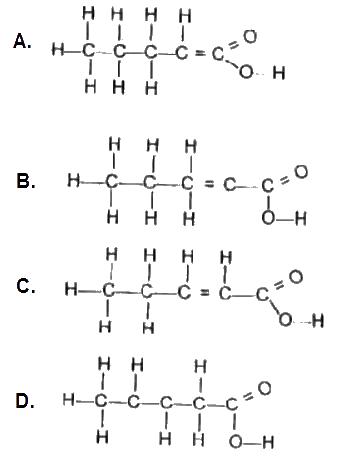
Use the options above to answer this question. Which is the structural formula for pent-2-enoic acid?
Options:A) A
B) B
C) C
D) D
Show Answer
The correct answer is C .